Best Residential Movers in Texas 2026 | Supermove
Looking for a moving company in Texas? You're probably looking for a company that has a good track record, and fits your timeline and budget. According to our d
Read more


.png)
The top 10 movers by revenue are running AI in their operations today. What was a novelty 12 months ago is widely in use now, and the pace keeps accelerating. The companies on the wrong side of that gap are now behind by a generation of technology, and the gap is widening every week.
Here's what’s happening in the market and how leaders are implementing AI today.
How AI is changing things:
Pen and paper aren’t connecting anything. And while the internet and mobile got the industry to the cloud, most enterprise movers still run on a stack of disconnected systems with humans doing the integration work through duplicate data entry.
Today, the customer calls and the mover controls the sales process through persuasion and information asymmetry, maybe they have some AI in place to take the call or log the information.
But, we aren’t far off from every consumer having their own personal AI agent that handles tasks like booking a move—the consumer’s AI initiates the call while the mover's AI quotes, runs compliance, negotiates, and books the move.
The movers that survive this shift will be either:
Everyone else gets compressed into commodity pricing — and commodity pricing in a market where AI keeps driving costs down doesn't leave a margin worth running a business on.
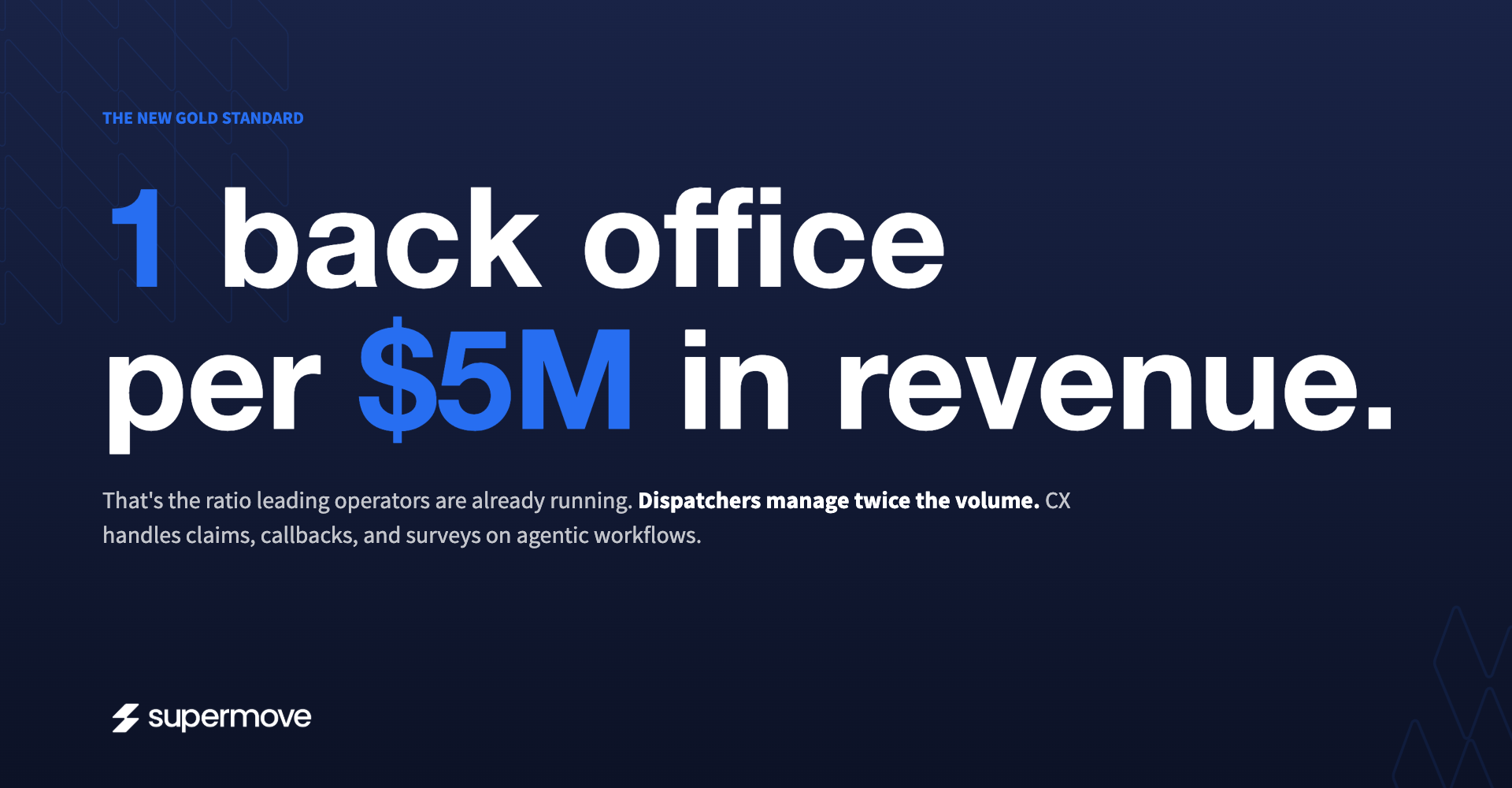
One back office employee per $5M in revenue.
That's what the leading operators are already running. Dispatchers manage twice the move volume. CX handles claims, callbacks, and surveys on agentic workflows. The headcount math has changed and fast enough that operators who staffed for last year's ratio are sitting on a cost structure their margins can't sustain.
Where you sit on this curve tells you what to do next.
Level 1 — Leader Use: The leader uses AI personally. Every operator in the top 10 is hands-on with AI. Not "I had my CTO look into it." Hands on the keyboard, asking questions, running experiments. AI adoption can't be delegated—if the leader isn't using it, the rest of the company won't either.
Level 2 — Experimentation: Four sub-stages
Most enterprise movers are stuck at stage 1 or 2 and don't know it. Another vendor demo won’t fix the problem, you need to force your team to solve their own problems with AI before they bring them to you.
Level 3 — Connect all your data: This is where most operators break. The typical moving company captures sales quotes, dispatch, accounting, warehousing, and van line data. The companies pulling away are capturing every email, every call, every SMS, every meeting transcript, every crew interaction on site, every claim detail, every cost line item. Most movers are losing this data the second it's spoken or written down but AI can't work on what it can't see.
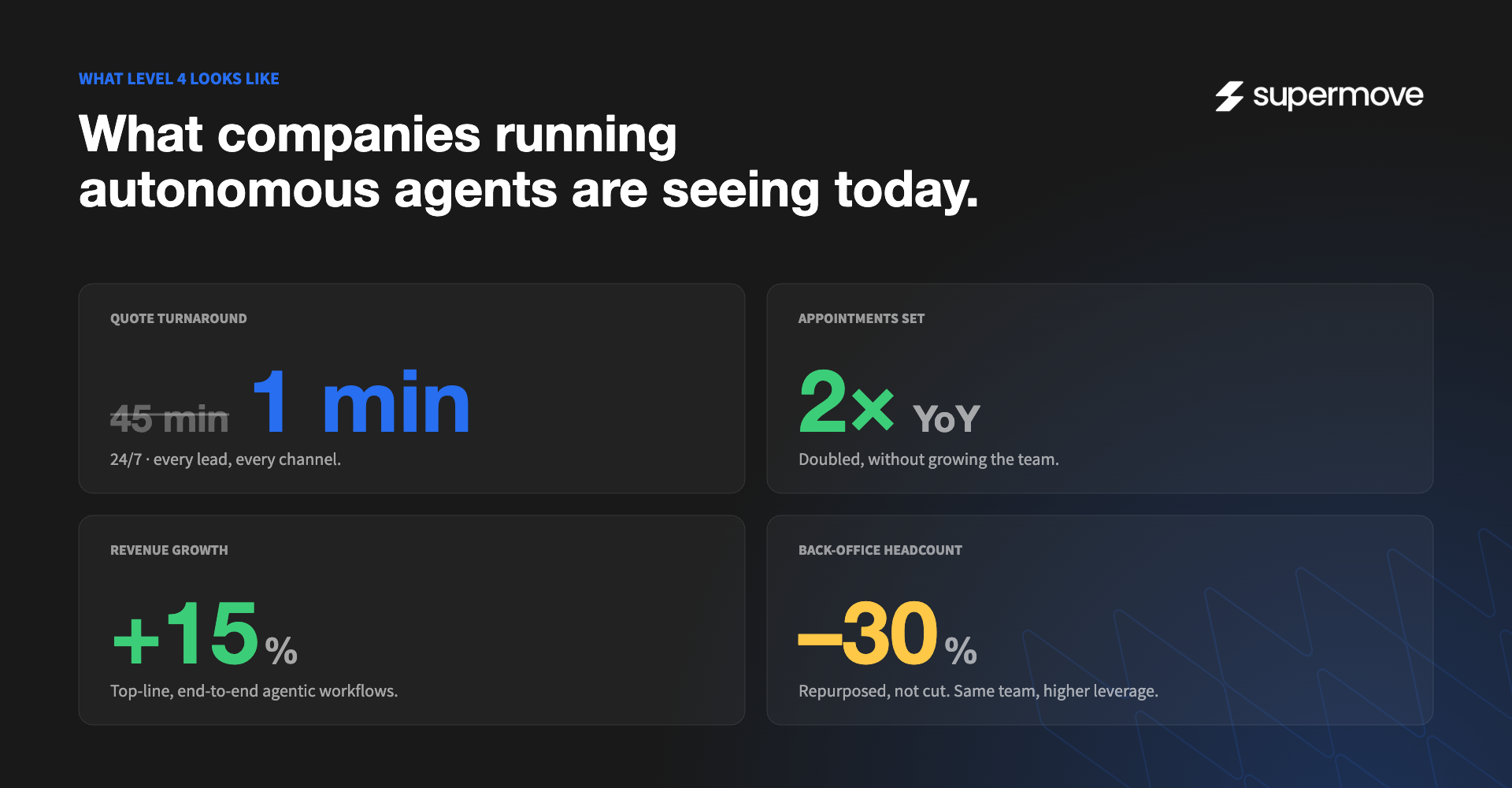
Level 4 — Autonomous agents: AI that runs on your business without you. Not assistants or chat interactions, but Agents that take a workflow end to end. The companies running this today are seeing 45-minute quote turnarounds compressed to 1 minute, 24/7; appointments set doubling year over year; 15% revenue growth with 30% of back office headcount repurposed.
This week find the waste. Pick 1-3 workflows that burn the most human hours and write them down. Don't pick the obvious ones but the ones that quietly eat the time of someone you can't afford to lose.
This month, solve those workflows with AI and push adoption. Get every person on your team using AI daily. Pay $100 to whoever solves the workflow best if it's a good motivator. Reward experimentation publicly and share wins and use cases often. The cultural shift will matter much more than the tooling shift.
In the next six months, ship the agents. Document what's still on paper or in someone's head digitally—markdown files are your friend. Launch at least one autonomous agent for a department. Rough is fine, it's better to iterate and improve as you go than wait for perfection. Often, you need to see it in action to figure out where to make improvements.
At Level 3, the bottleneck is data capture. Your systems are in place but the company is still losing data to in-person crew conversations, paper inventories, dispatcher notes that never get logged, calls that aren't recorded. Pick your top three sources of lost data and put a realistic capture system on them this quarter. AI built on partial data produces partial answers.
At Level 4, the focus shifts to volume. Launch at least one new autonomous agent per quarter. The companies pulling away aren't the ones with a few polished agents — they're the ones with the most agents in production, learning from real use, and iterating constantly.
The playbook works no matter what software you're running. But your platform sets the ceiling on how far you can take it.
There's a real difference between AI bolted onto a legacy stack and AI built into the system your operation runs on. Bolt-on is a chatbot, maybe some automations, mostly disconnected. AI-native is sales, ops, claims, and finance all running on the same connected system, with intelligence that already knows your real moves, your real customers, your real crews, and your real margins. Nothing to export, nothing to connect, nothing to explain. The longer you run on it, the smarter it gets.
That's the bet Supermove is making. The platform you deploy today won't be the platform you're running 12 months from now, because the product has to keep up with AI itself. Most legacy vendors are still trying to add basic AI to products built for a different decade. Supermove was built for where the industry is going, not where it's been.
The gap widens every day you wait.