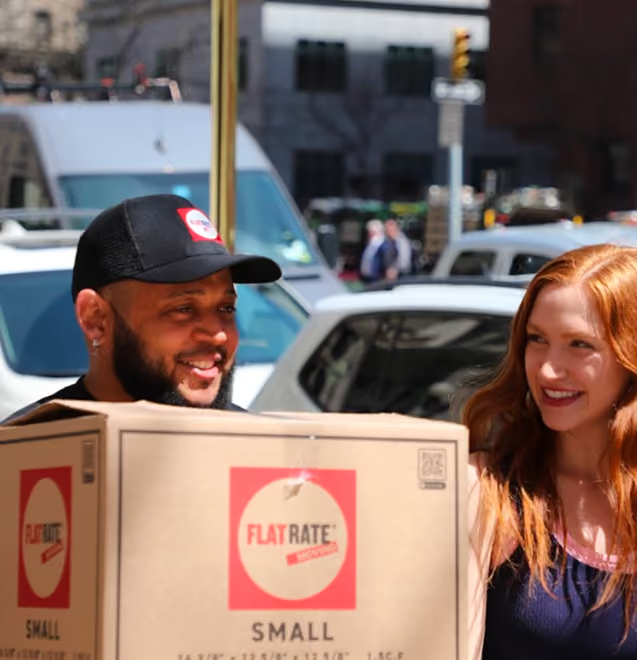
Sharone was in his early twenties when he stumbled into the moving industry. He spent one summer on the trucks, and then a few months in the office of a well-known New York company called Shleppers. He observed he spent a considerable amount of time fielding a question that came from nearly every customer who called: "Do you do flatrate?"
The answer was always no, and interestingly enough nobody did. The entire industry ran on hourly pricing which was a bit too open-ended and unpredictable for customers who wanted to know exactly what moving day would actually cost. Sharone also observed a complete contrast when quoting customers that were moving internationally. He could give binding prices to London, Paris, or Dubai and give prices calculated on cubic meters accurate enough to guarantee an exact dollar amount. And yet for a family moving from Fifth Avenue to the Upper West Side, a trip of a few miles, nobody could say what the bill would look like at the end.
"I was like, this is crazy," Sharone recalls. "We can give a price all the way to London and there is no problem, and we cannot do it for somebody who wants to move within the same city."
Being sharp and business minded he saw an opportunity to build the answer himself. A friend with coding ability helped him develop a simple inventory tool that calculated volume, added parameters for stairs and access complexity, and accounted for the specific demands of different furniture types. That software became the seed of everything, and once Sharone understood that volume dictated time, and that time could be modeled accurately enough to guarantee a price, the concept crystallized. Thus became a moving company built entirely on the promise that the number on the estimate would be the number on the invoice.
In 1991, he patented the name Flatrate Moving, and launched it out of New York City. The industry pushed back hard. For the first two years, the established hourly movers waged a lobbying campaign through the Department of Transportation, arguing that flatrate pricing was improper and even harmful to the industry Sharone fought back, appeared before regulators, and eventually the DOT granted Flatrate full approval to operate. In Sharone's telling, the two parties became lasting allies.
"I knew we were doing something right," he says. "I thought the responsibility of the Department of Transportation was to protect consumers, not to protect moving companies trying to make the experience more expensive."
New York had a moving industry with a troubled reputation bad enough to have drawn a congressional investigation called the Goodman Report, which documented widespread price manipulation and consumer abuse. So when Flatrate arrived offering certainty, something that had never existed, the response from customers was immediate. The phones rang from day one.
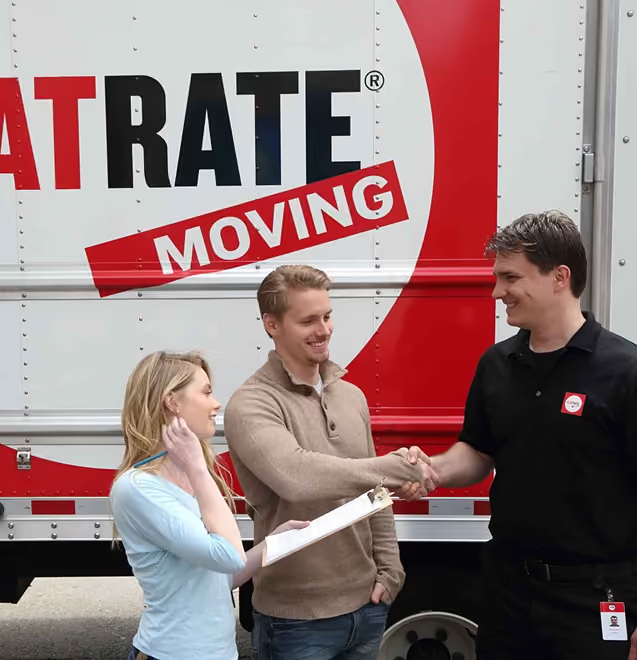


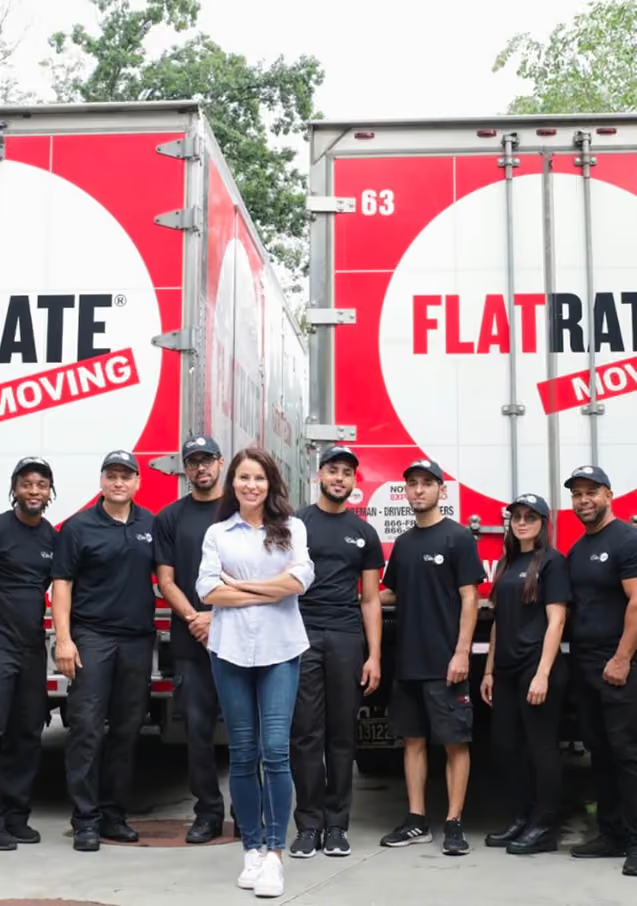
Sharone still runs Flatrate to this day, and he has for 35 years. He operates out of a building in the South Bronx that he purchased shortly after the company was founded, which he sees as a physical expression of the commitment he made to this neighborhood and this industry when he was still in his twenties.
What keeps him going is not the business itself; it's the people in it. His management team has been with him for 20 years or more. "Twenty years is not a long time here," he says. They share the same set of values, the same way of looking at what moving should be. They have stayed not because the industry is easy, but because something about Flatrate has made staying worth it.
He describes his sales team as the most professional in New York City. The people who have grown up inside Flatrate started as movers, and carry the company's values into every interaction they oversee. The culture is less about a training manual; it's more of a function of who stayed and why.
That culture begins with a philosophy about the customer that Sharone has held since the company's first year: moving is the third most traumatic life experience according to psychologists. Customers arrive stressed, anxious, and braced for something to go wrong. Flatrate's entire model is built around reversing that expectation, not with scripted reassurances, but with an operation so dialed in that the customer's stress is absorbed before it can take hold.
Sharone doesn't just train in how to lift and load, but even more importantly provides training in the customer experience. This includes what the team is expected to project, how they are expected to carry themselves in someone's home, and what zero tolerance for exploitative behavior looks like in practice. This is a standing commitment throughout each employee's journey at the company.
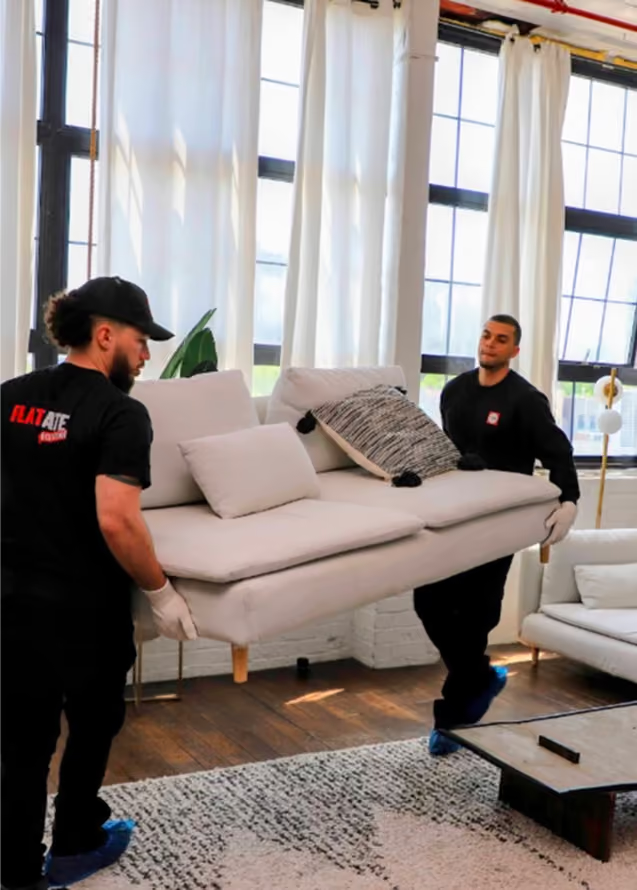
Ask Sharone what you'd see if you followed a Flatrate crew for a day, and his answer is specific. "The difference that is clearly visible in your eyes," he says, "is that our furniture looks beautiful when it comes out of the home. Perfect, double-wrapped, and respected." Every piece leaves under a moving blanket, over that is shrink wrap, and on anything that warrants it, corner protection. By the time a Flatrate crew has finished preparing a home's contents for transport, each item looks as if it's being shipped across an ocean.
That standard is the physical manifestation of the company's core promise. Sharone distills the entire customer relationship to three things: the price will not increase, the furniture will be protected, and the team will be respectful.
What sets Flatrate apart operationally is a thorough level of pre-move preparation. Where others send a rough estimate and figure out the rest on the day, Flatrate asks the questions other movers don't, like questions around the storage room in the basement, the rugs on the floor, the items a stressed customer may not have thought to mention. They even build in a deliberate assumption that clients will forget roughly ten percent of their belongings. That buffer is absorbed by the company, not passed back to the customer as a surprise charge onmove day.
"We assume the client doesn't know," Sharone says. "So on the day of the move, there are no surprises."
Flatrate has moved 500,000 clients, and of those, the majority have referred or returned. The 100th-move milestone, celebrated with a complimentary job, is a real number that real clients have reached.
On the labor side, Flatrate operates exclusively with W-2 employees, paid above minimum wage, with full benefits. In a market where
Sharone built Flatrate on a gamble that the industry had decided wasn't worth taking. Hourly pricing carried zero risk for the mover. The customer absorbed all of it. Flatrate's model inverted that equation: the company takes the risk, guarantees the outcome, and bets that the discipline to deliver on that guarantee is worth more in the long run than the margin protection of an open-ended bill.
It is, in his view, a fundamentally long-term way of thinking. "A businessman who thinks only about the short term would want hourly rate, " he says. "Zero risk. But we proved that you can make a great business by taking some risk and sticking to it."
At peak, Flatrate ran 120 to 140 trucks, Sharone made a deliberate decision to scale back. Not because growth became unsustainable, but because quality did. "Controlling quality on a big platform is very challenging," he says. "I learned that." Today, with 48 trucks, the operation is significant but manageable enough that the standard can be enforced on every job.
The franchise model Flatrate is launching in 2026 is built on those lessons. Rather than scaling one massive operation, Sharone envisions 100 franchisees, each running no more than 20 teams. Small enough for the owner to know every mover, and for quality to travel with the brand.
"I believe that | did a revolution in New York City," he says, with the calm confidence of someone who has watched 35 years of evidence accumulate. "' would like to give it to the rest of America because the rest of America is still hourly. It is still the same as New York used to be 30 years ago."
"Think long term. Invest in the ability to have an excellent, mind-blowing experience for the client. That will pay off most.”

Community is built into the company's DNA. Flatrate offers free moving services to any nonprofit that needs them: food banks, coat drives, book distribution programs, etc. They run a client donation program, supplying free boxes and collecting clothing and books that customers no longer need, then delivering those donations to any organization willing to take them. Sharone says the company is "hunting for it," actively seeking opportunities to put their trucks and crews to work in service of the city that built them.
As of mid-2026, Flatrate is experiencing an unprecedented spike in international moves. Sharone attributes it to the fact that some people are returning to America, and some are leaving. Either way, the phones are ringing. "I think we're going to have a great summer," he says.
The franchise launch will expand the model outward, and the South Bronx building will remain the company's home. And Sharone, 35 years after a problem nobody else in the industry could answer, is still answering it.
FOUNDED
19991
CLIENTS MOVED
500K+
TRUCKS • OWNED FLEE
48
YEARS/FOUNDER-LED
35
Headquarters
The Bronx, New Yor
Founder
Sharone - founded 1991; still leads the company today
Employees
150-200
Clients Moved
500,000+
VAN LINE
Founding agent of United Van Lines (1947); Don Hindman serves on the Unigroup Board of Director
Service Lines
Local residential, long-distance, international, military/government, VIP, commercial
The Innovation
Pioneered and patented the guaranteed flat-rate pricing model for moving (1991)
Award
Consumer Choice Post: Best Consumer Value 2025
Franchise Launch
2026 - up to 100 franchisees, each running no more than 20 teams