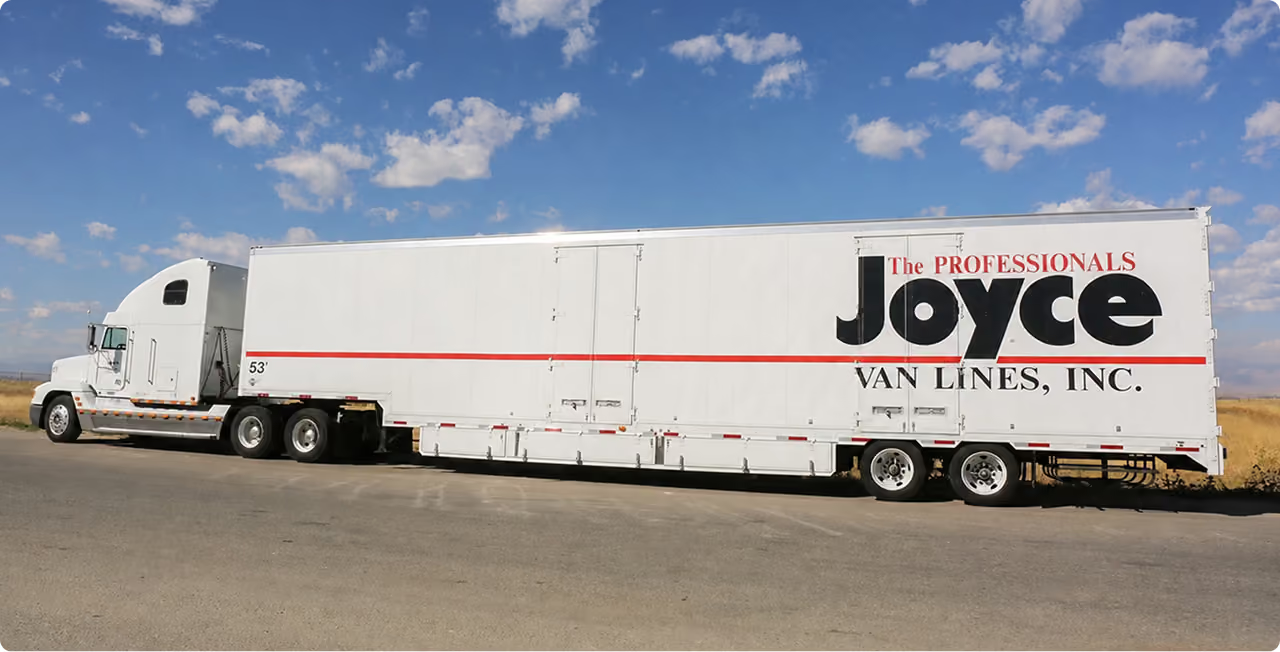
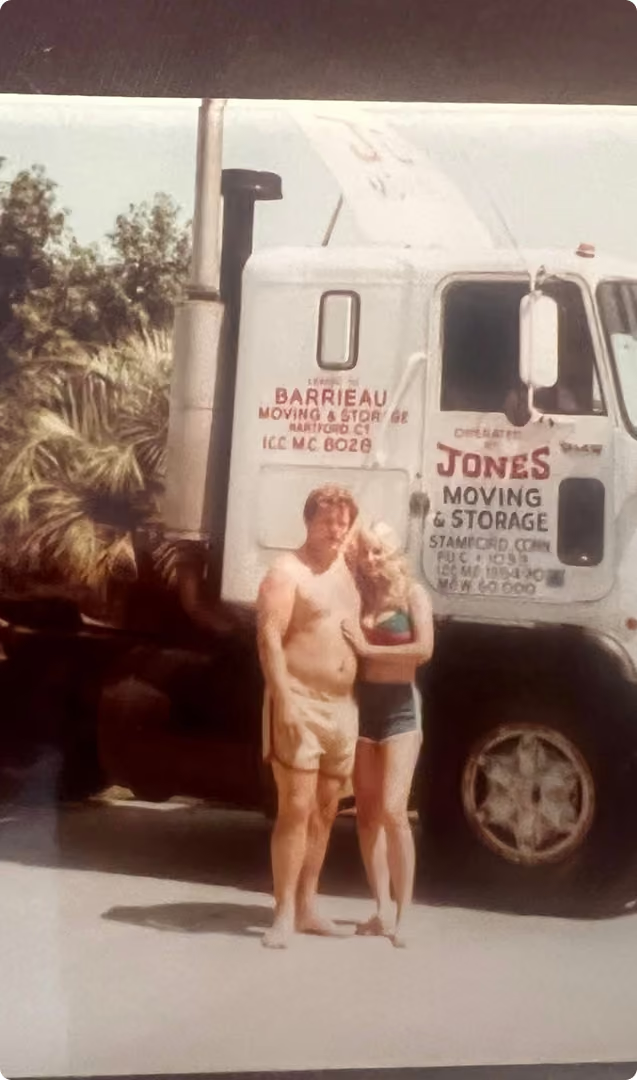
William Joyce spent years as an over-the-road driver for a string of van lines and agents. He grew tired of working for someone else and wanted something different than what he was experiencing with the van line structure. In 1981, he decided he could do it better on his own, and started his own moving business in Stamford, Connecticut. A close family member and realtor by the name of Ellie Wayne, who lived in Stamford at the time, helped fund the launch and, more importantly, kept referring business his way for years.
Those early years were just the William, his wife and one truck. It was a true zero-to-one grind. William’s father had to do almost every single role himself becoming proficient in everything and an expert in a few things. Over time, William’s relentlessness turned the company into a 70-truck, over-the-road fleet running out of 13 terminals.
William Joyce Jr. grew up in the business. He jokes that the first time he got fired was at two years old after he started answering the phones and was promptly sent back to daycare. Growing up around the business didn't automatically mean he wanted to run it however. He spent time working for Joyce in Connecticut, still genuinely unsure about taking it over.
In 2003, the opportunity to open the company's Fort Myers terminal appeared and William Jr decided to seize the chance to start and scale it from scratch. They had 200 empty storage vaults, no drivers and no infrastructure. William Jr had three guys he already knew and trusted, and brought them down to build it from the ground up. Three years later, the terminal was a fully built-out 53,000-square-foot facility, completely full and out of space, needing more warehousing just to keep up with storage demand.
When September 11th hit, it forced a heavy reduction. Then again their business took a hit in 2008. William Sr. had fortunately had sold the company's largest warehouse, a building in Oxford, Connecticut that he'd built himself, right at the top of the market. The deal hadn't closed yet when the financial crisis hit, but the buyer had already put down a non-refundable deposit of roughly $200,000–$300,000, extremely high at the time, which kept the sale from collapsing and gave the company the cushion it needed to get through.
Since taking the reins, William has spent his tenure, first as COO, now as CEO, taking the company from "the largest little guy to the smallest big guy" in his own words. Under his leadership, Joyce Van Lines is now officially larger than it has ever been.

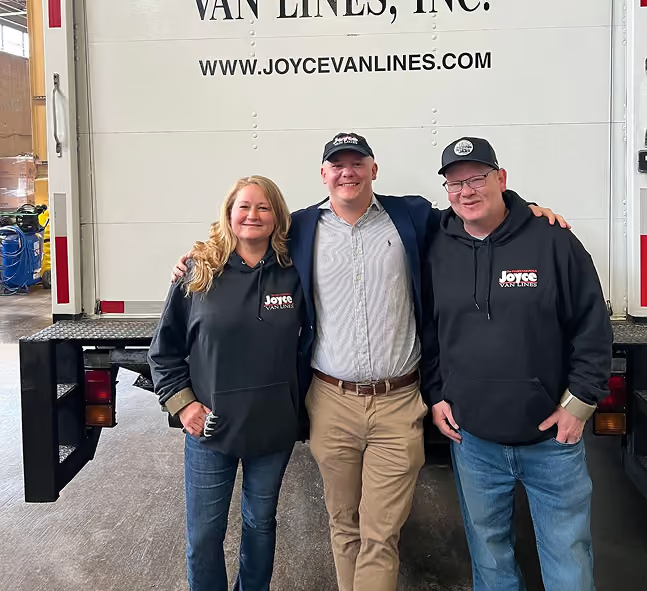
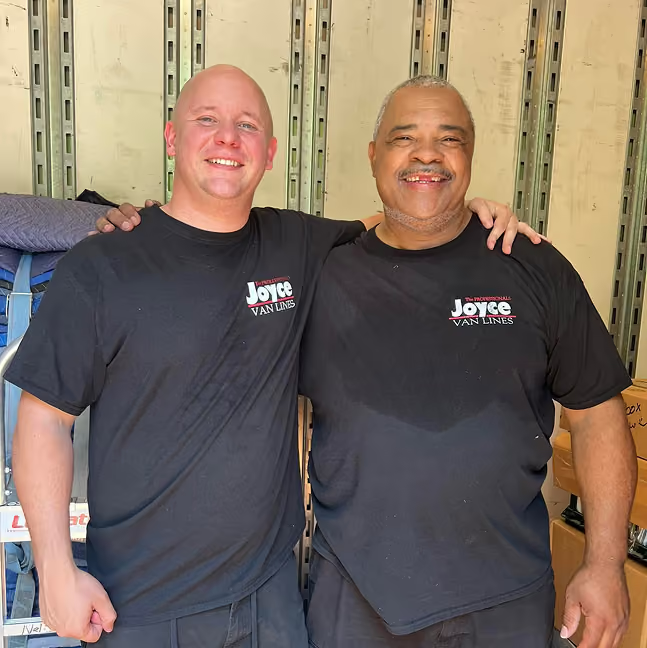
That experience where William Jr built the Fort Myers location from scratch is where he found his footing, and where his attachment to the business became personal rather than inherited. He's said plainly that if his father had ever sold the company, he'd have been upset, and not about the money. He doesn't think he'd enjoy retirement more than doing this, even though most people find the industry chaotic and stressful. He and company president, Jan, have built that into the culture at Joyce: when things start to feel too calm, too much like a lull, it's uncomfortable. They'd rather embrace the chaos and dance with it.
Asked what keeps him going after all these years, William doesn't hesitate: it's fun. He's close with the people he works with, it's something he's passionate about and good at, and it gives him a sense of tangible impact that most jobs don't.
That experience where William Jr. built the Fort Myers location from scratch is where he found his footing, and where his attachment to the business became personal rather than inherited. He's said plainly that if his father had ever sold the company, he'd have been upset, and not about the money. He doesn't think he'd enjoy retirement more than doing this, even though most people find the industry chaotic and stressful. He and company president, Yon, have built that into the culture at Joyce: when things start to feel too calm, too much like a lull, it's uncomfortable. They'd rather embrace the chaos and dance with it.
William has a way of explaining that mentality that sticks: he likens long-distance moving to a "5, 100-hand blind poker table," compared to the "one, two-hand" version that is local moving. Most people look at a moving company's revenue line and stop there. They don't think about the repair bills, or what it takes to handle a breakdown at night, in a California time zone, on a mountainside in some town nobody's ever heard of. That's the part of the job William says most outsiders never see.
Asked what customers say about him personally that he's most proud of, William's answer is that they rarely say anything about him at all, and he prefers it that way. Whatever compliments do come in, he passes straight to the crews they're actually about. As he puts it, he's only as good as his team.
Asked what keeps him going after all these years, William doesn't hesitate: it's fun. He's close with the people he works with, it's something he's passionate about and good at, and it gives him a sense of tangible impact that most jobs don't.
That reliance on people isn't just sentiment, it's advice he'd give to anyone starting a moving company today: it's a marathon, not a sprint, and the biggest early mistake he sees is founders trying to do everything themselves. You have to be willing to lean on other people if you actually want to build something that lasts.

About 90% of Joyce's revenue is over-the-road, and nearly all of its crews are contractor-based by design so that they have hungry, entrepreneurial people with real skin in the game, not employees clocking hours. The structure lets top performers scale well past a single truck: one master contractor currently runs more than 10 crews himself on a given day, each with larger goals than just their own rig.
That contractor model isn't just philosophy, William's father tested it directly. Early on, he split the fleet roughly in half between contractors and employees and tracked damage claims over the better part of a year. The contractor half had literally half the claims of the employee half. Contractors fixed their own equipment, protected freight more carefully, and would kick underqualified help off a job site rather than risk their own reputation. That one experiment is still the reason Joyce leans as hard as it does on ownership and accountability over headcount.
It's also produced an unusual byproduct. William's father has helped create three different millionaires over the years: contractors who started with Joyce, grew their own fleets inside the company, and eventually got too big to stay. At that point, the conversation was always the same: "You're too big for us. You need to branch off, start your own cod arm, get an interline set up — we can keep doing business, but on a different footing." Those contractors now run their own larger moving businesses.
Leadership leads from the front, not from behind a desk. William drove a truck himself as recently as last year. This year is the first time in his career he hasn't driven at all, and he still works dispatch and has spent time on the docks. That same instinct shapes how the company handles problems: rather than requiring every fix to be escalated up to William for sign-off, decision-making is pushed down to whoever's closest to the problem. By the time an issue reaches him, it's usually already resolved, and his role is just to give feedback or say "good job."
When a customer says a job had real problems early on but the team, people like Yvette, Jan, and Mike, completely turned it around, that's the moment William points to as the clearest evidence of what makes Joyce different. Making things right when they've gone wrong isn't ROI-positive in the short run, and very few companies are willing to actually do it.
William describes his own era running the company as a deliberate contrast to his father's style. William's version is built around teaching people, giving them the tools, and then letting them perform their own way.
He builds his leadership team the same way he builds his crews: looking for people whose strengths complement rather than duplicate his own, pairing personalities that create real synergy, and prioritizing clear, compatible communication styles above almost everything else. His baseline assumption is that people are naturally bad at communicating. The goal isn't perfection, it's making it "less bad" over and over until, almost without noticing, a team finds itself having clear conversations about topics it never could before. He sees the same principle at work in the moving experience itself: moving is never going to be a genuinely pleasant process for a customer, but making it less bad, consistently, is what separates a good moving company from an average one.
He also leans on a piece of industry wisdom he's carried his whole career: moving isn't really a moving business, it's a real estate business with a bad moving habit. The biggest decision of the last two years proved it out by selling the company's Florida warehouse for roughly three times its original purchase price, then locking in a new lease nearby at a rate William still says he's shocked he got. It's part of a broader asset strategy: rather than just take profit and pay tax on it, Joyce reinvests into new trailers and tractors, taking the depreciation and letting the fleet compound instead of stalling out at the revenue plateau, often around $1-2M, where a lot of moving companies get comfortable and stop growing.
William is quick to correct the assumption that a moving company CEO is sitting on liquid wealth. Taking on debt is a fast way to go bankrupt in a down cycle, so the business stays "tractor-trailer rich" instead with hundreds of trucks and trailers on the books.
Growth is measured on purpose. William targets roughly 10-20% annual growth; push past 20% and margins start to strain, but shrink faster than 5-10% and the pain compounds just as fast. Just as important as the growth rate is account diversification: making sure Joyce is never dependent on any single account, so no one relationship going wrong can put the business at risk.
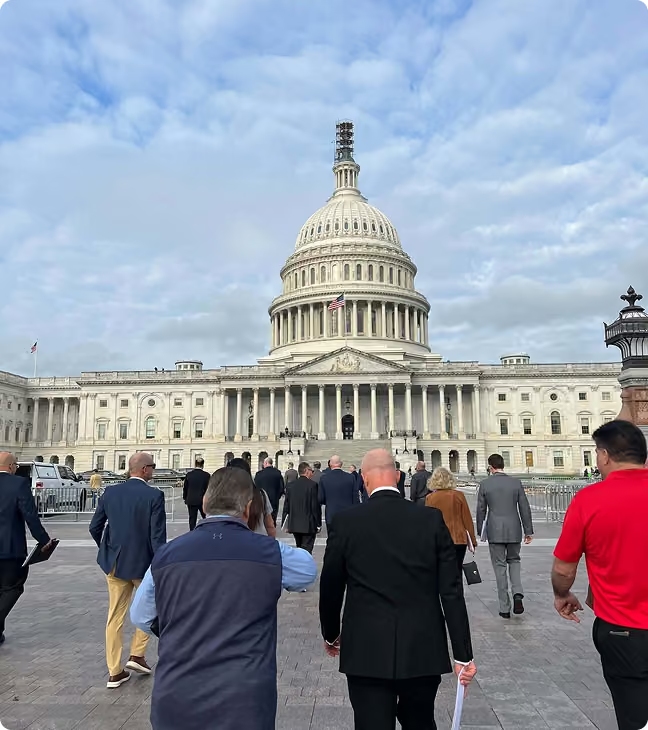
Joyce Van Lines' primary charitable partner is Schoolhouse Connection, an organization William is personally passionate about that provides housing and stability support to students who've been accepted into college despite experiencing homelessness or housing insecurity. As William describes it, the mission is giving fishing rods to the people with the most potential to be great fishers; not just writing a check, but helping students go from an unstable situation to a stable one and adapt to a completely new environment. Schoolhouse Connection will be one of the main charity sponsors for donations at an industry event Joyce is involved with this September.
On the industry side, William is active at both the regional and national level. At the regional level, he's a longtime supporter of the Southeast Regional Relocation Conference (SRRC) and recently helped stand up the Indianapolis Relocation Council alongside Martin George of LTC Global and a colleague named Kaylee. At the national level, he's a member of IAM, WERC, and the American Trucking Associations (ATA).
FOUNDED
1981, Stamford, Connecticut
Founders
William's father and mother (the company's first employee)
Leadership
William Joyce, CEO; Yonatan Manzano, President
Locations
5, including a newly added Texas terminal
FLEET
~110 trailers, ~83 power units, ~55-57 owner-operator drivers
Employees
32 corporate employees, plus a primarily contractor-based crew workforce
Coverage
Ran jobs in all 50 states in each of the last two years
Community
Schoolhouse Connection — housing security for formerly homeless and housing-insecure college students
Industry Involvement
SRRC, Indianapolis Relocation Council, IAM, WERC, ATA