.png)
Supermove Funding: Backed by the World’s Best Investment Firm
Discover why the top VC firm chose to back Supermove and how it's reshaping the future of moving and storage.
Read more




.png)
A few years ago, Supermove CEO Wonjun Jeong watched a self-driving car glide past him on a delivery run. Minutes later, the mover next to him handed a customer a paper slip and wrote her credit card number on it by hand.
Same street. Same afternoon. Two totally different eras of technology, standing side by side.
That gap is what Supermove closed last week. Here's what shipped, and why it matters for your business.
This is the biggest thing we've shipped since founding Supermove in 2019, and it's been seven years in the making.
Most "AI" tools in moving today do one thing: they help a person work faster. A copilot drafts an email. A voice agent answers a call. Someone still has to finish the job.
Autopilot is a different category. Autopilot finishes the job. Point it at a task, like checking in with a customer, resolving a claim, or reconciling a carrier bill, and it completes that task on its own. It only comes to a person when something falls outside the rules you've set.
Here's the clearest way to think about it, borrowed from an industry everyone already understands: driving.
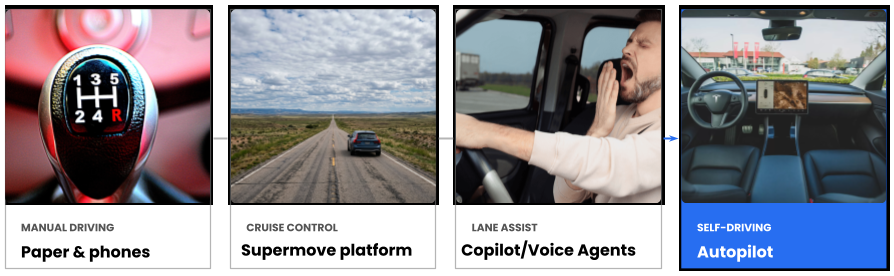
We are building for the last category — self-driving software. It already exists outside our industry, so it's not experimental anymore. Driverless taxis now complete tens of millions of paid rides with no one behind the wheel. In healthcare and legal, AI agents are handling scheduling, reconciliation, and contract paperwork end to end, not just flagging it for a person to finish.
We’ve always operated with the mindset that moving should be on the frontlines of technological advancement, not the industry that’s lagging behind.
The vision hasn't changed since we started: one platform that runs the entire moving company. What's changed is how much of that platform can now run itself.
.png)
Before we built software to run the operation, we spent two years proving AI could reliably assist it. That work is already producing results our customers can point to:
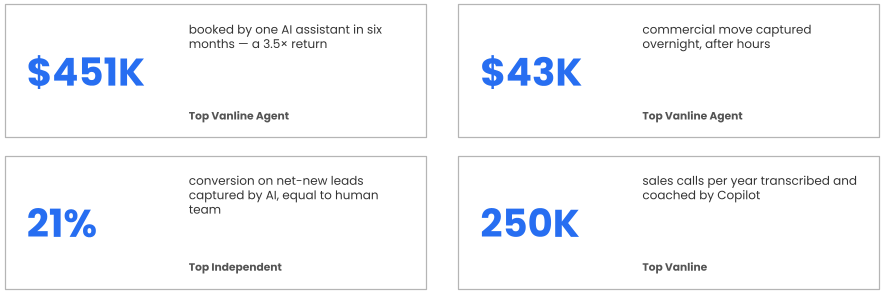
"That was AI assisting your team. What launches now is AI doing the work."
Wonjun Jeong, CEO
It not only does the work, it analyzes the work, surfaces insights and lets your leadership drive with the intelligence they need.
Autopilot is built on four parts that work together: a workforce of agents, a way to direct them in plain English, an inbox that catches anything that needs a human, and playbooks that define what "good" looks like for your business:
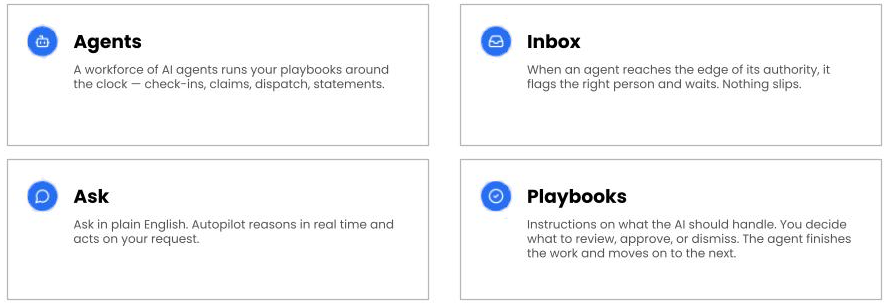
Agents are the workforce inside Autopilot. Once you turn one on, it runs your playbook around the clock, no lunch breaks, no shift changes. In the reveal, an Agent handled a customer's request to shift his arrival window from start to finish. Nobody on the team had to touch it.
Ask is how your team talks to Autopilot. Type a question or a request in plain English, like which trips still need a driver, and it reasons through the answer in real time and takes action if you ask it to. It’s basically ChatGPT but all for your business data.
Here’s an example of a Dispatcher trying to recall a detail regarding his shipment:
What’s even more useful is that moments like this in the video, when your team approves a new process, they can actually automate it moving forward by turning it into a playbook.
Playbooks are the rules your business sets. You decide exactly what Autopilot is allowed to handle on its own and what still needs a person's sign-off. Most companies start with a single playbook, let it earn trust, and expand from there.
As you’d imagine, Inbox is what you check every morning, and every so often.
In Autopilot, Inbox is the safety net. Whenever an Agent hits something outside its authority, like a scope change that affects the price of a move, it doesn't guess. It routes the decision to the right person with everything they need already attached, so approving it takes seconds instead of reconstructing the whole story.
In this example, you can see the Accountant’s Inbox showing what statements the Agent processed, and which statements require their review.
Here's a snippet of what we walked through live on the Autopilot Reveal. It’s an example of a real pre-move check in, running inside Autopilot.
"Every industry is getting its autonomous layer. Moving is too."
Wonjun Jeong, CEO
Supermove's mission hasn't changed since 2019: one platform that runs the entire moving company. Autopilot is the first time that's literally true.
Autopilot runs on credits tied to completed work, not seats or licenses. You pay for what actually gets done. The advice from Supermove's own team: start with one playbook, let it prove itself, then expand.